Have you ever wired thousands of dollars to a supplier in China, only to receive poor-quality products, delayed shipments, or no products at all?
Unfortunately, you’re not alone.
Every year, thousands of importers lose money due to unreliable suppliers, communication barriers, hidden costs, and quality control issues. Many businesses enter the Chinese sourcing market expecting significant savings, only to discover that finding trustworthy suppliers is much harder than they imagined.
The reality is simple: the success of your sourcing project depends heavily on who represents your interests on the ground in China.
That’s where a professional sourcing agent comes in.
As Yingying, founder of Yinhan Sourcing in Shenzhen, I’ve spent years helping overseas buyers source products from China safely and efficiently. During that time, I’ve worked with startups, Amazon sellers, wholesalers, retailers, and established brands across multiple industries.
I’ve seen buyers lose tens of thousands of dollars because they chose the wrong sourcing partner. I’ve also helped businesses reduce purchasing costs, improve product quality, and scale their operations by selecting the right suppliers and implementing effective quality control processes.
In this comprehensive guide, I’ll share exactly how to choose the best China sourcing agent in 2026, based on real-world experience and hundreds of sourcing projects.
By the end of this article, you’ll learn:
- What a China sourcing agent actually does
- The different types of sourcing companies
- The biggest red flags to avoid
- A proven 10-point evaluation checklist
- Typical sourcing fees and hidden costs
- How our sourcing process works at Yinhan Sourcing
- Real client success stories
Plus, you’ll get access to our Free China Sourcing Agent Evaluation Checklist that you can use when comparing potential partners.
Let’s get started.
What Is a China Sourcing Agent, and Why Do You Need One?
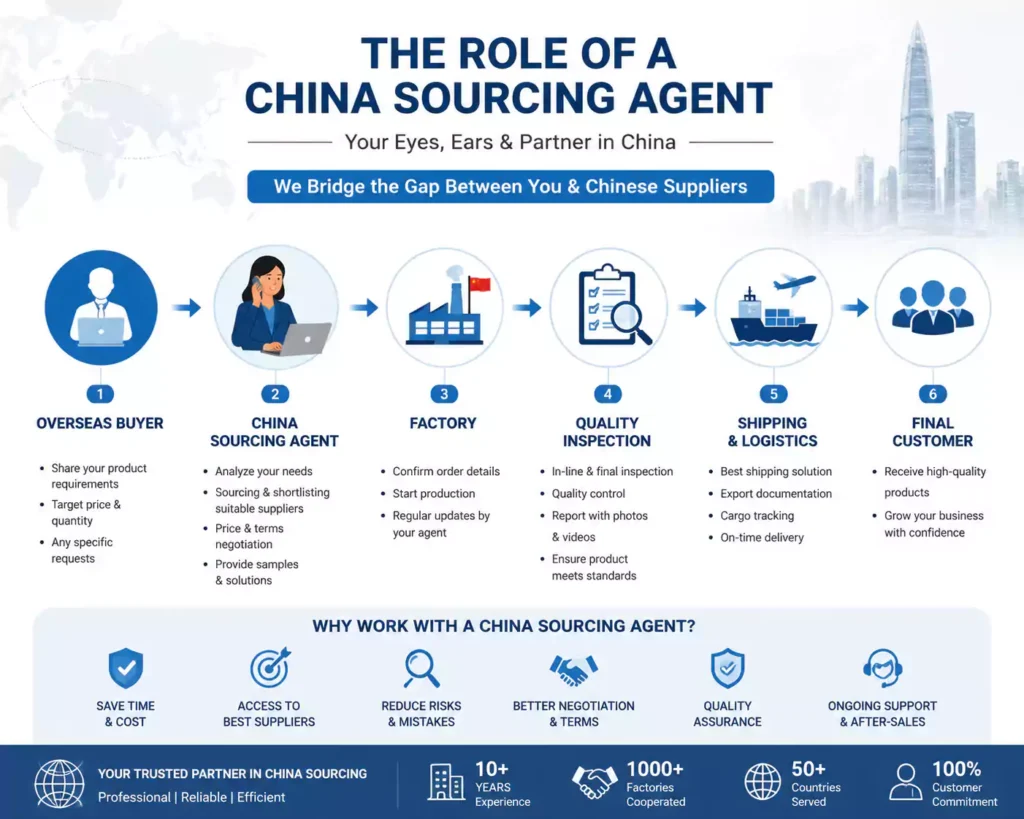
A China sourcing agent acts as your local representative in China. Their job is to help you identify reliable manufacturers, negotiate pricing, manage production, inspect quality, and coordinate logistics.
Think of a sourcing agent as your purchasing department in China, without the cost of hiring a full-time local team.
What Does a Sourcing Agent in China Do?
A professional sourcing agent typically provides:
Supplier Identification
Finding qualified manufacturers that match your product requirements.
Supplier Verification
Checking business licenses, factory capabilities, certifications, and production capacity.
Price Negotiation
Negotiating better pricing, payment terms, and production schedules.
Product Development
Supporting custom products, private labeling, and packaging design.
Quality Control
Conducting inspections before products leave the factory.
Logistics Coordination
Managing shipping, customs documentation, and freight forwarding.
Why Buyers Need a Sourcing Agent in 2026
The Chinese manufacturing landscape has become increasingly complex.
Challenges include:
- Rising labor costs
- More supplier competition
- Quality inconsistencies
- Intellectual property concerns
- Supply chain disruptions
- Language barriers
Global supply chains have become increasingly complex and data-driven. Without local expertise, buyers often struggle to distinguish reliable factories from trading companies or fraudulent suppliers.
Real Client Example
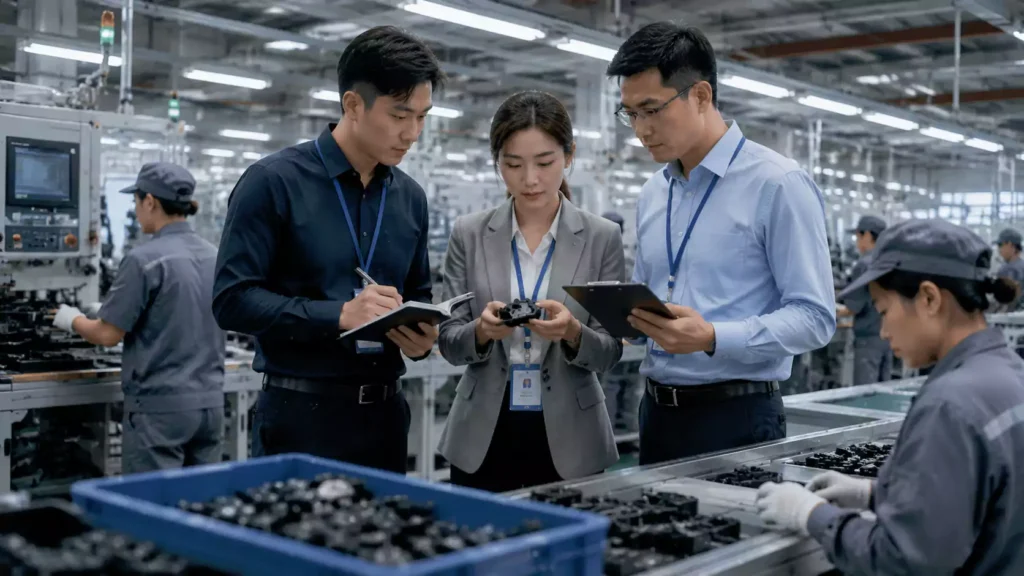
One of our clients from the United States contacted us after losing nearly $12,000 on a private-label product order.
The supplier had impressive photos, a professional website, and excellent communication before payment.
After we received the deposit, the supplier repeatedly delayed production. When the products finally arrived, over 40% failed quality inspection standards.
We helped the client identify a verified manufacturer, redesign the product specifications, and establish inspection checkpoints.
The result:
- 18% lower unit cost
- 95% quality pass rate
- Reliable production timeline
- Long-term supplier partnership
This experience highlights why choosing the right sourcing partner matters.
Types of China Sourcing Agents (+ Red Flags)
Not all sourcing providers operate the same way.
Understanding the differences can save you significant time and money.
Comparison Table
| Factor | Sourcing Agent | Trading Company | Factory |
|---|---|---|---|
| Multiple Supplier Access | Yes | Limited | No |
| Product Flexibility | High | Medium | Low |
| Price Transparency | Usually High | Often Low | High |
| Quality Control | Independent | Internal | Internal |
| Negotiation Power | High | Medium | Low |
| Best For | Importers & Brands | Small Orders | Single Product |
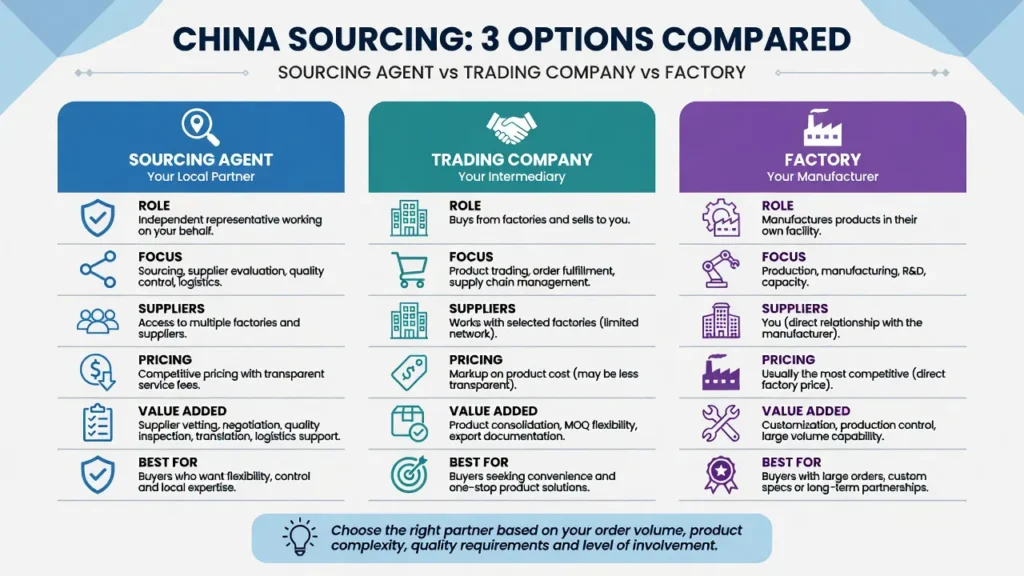
Independent Sourcing Agent
Works on behalf of buyers and helps source products from multiple factories.
Advantages:
- Flexible sourcing
- Better negotiation leverage
- Independent inspections
- Broad supplier network
Trading Company
Purchases from factories and resells to buyers.
Advantages:
- Easy communication
- Consolidated purchasing
Disadvantages:
- Higher costs
- Less transparency
Direct Factory
Manufactures products directly.
Advantages:
- Lower pricing
- Technical expertise
Disadvantages:
- Limited product range
- Less flexibility
8 Red Flags When Choosing a China Sourcing Agent
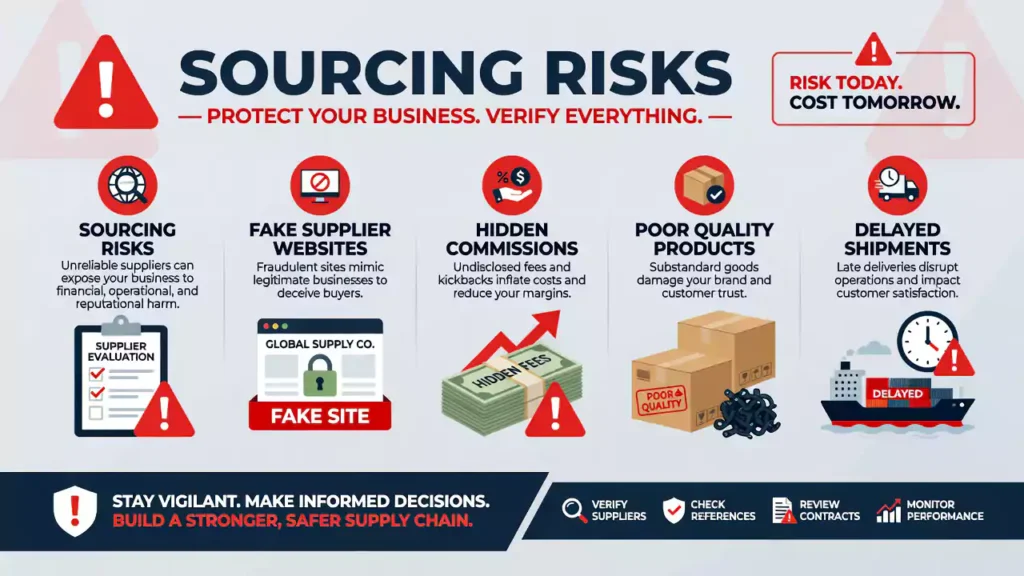
1. No Physical Office
A legitimate sourcing company should have a verifiable business location.
Ask for:
- Office photos
- Company registration
- Business license
2. No Factory Visit Evidence
Professional sourcing agents regularly visit suppliers.
Request:
- Factory audit reports
- Visit photo
- Inspection videos
3. Unrealistic Price Promises
If someone claims they can reduce costs by 50%-70%, be cautious.
Extremely low pricing often leads to:
- Quality problems
- Hidden fees
- Supplier substitution
4. No Quality Inspection Process
Quality control should be documented and systematic.
5. Poor Communication
Slow responses before payment often become worse afterward.
6. No Client References
Reputable agencies should have testimonials and case studies.
7. Hidden Commission Structure
Some agents secretly receive supplier kickbacks.
This creates a conflict of interest.
8. No Written Agreements
Professional sourcing relationships should include contracts covering:
- Fees
- Responsibilities
- Confidentiality
- Quality standards
The Ultimate 10-Point Checklist to Choose the Best China Sourcing Agent
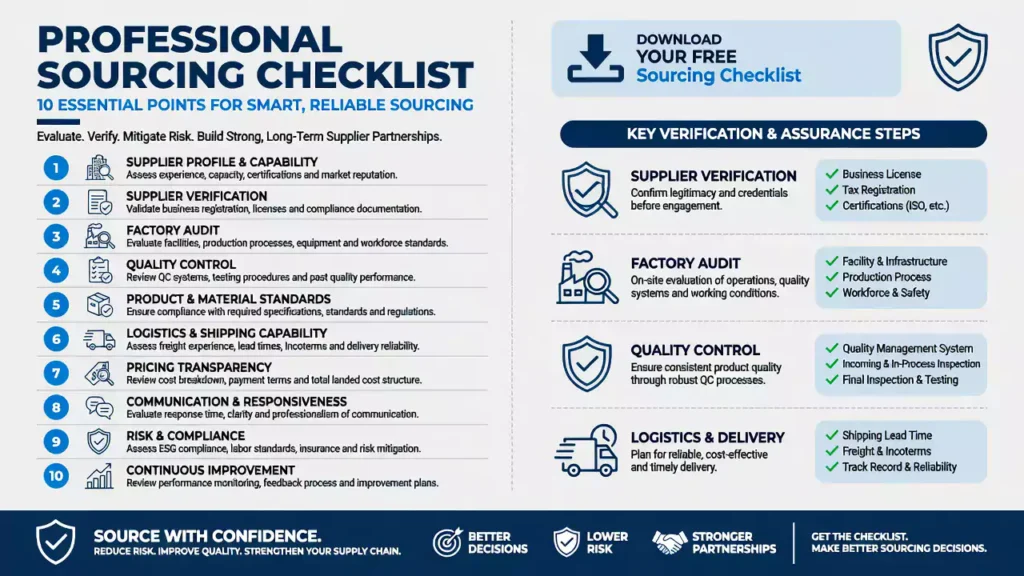
Use this checklist before signing with any sourcing company.
1. Verify Company Registration
Ask for:
- Business license
- Company registration documents
- Tax registration
Proof We Provide
At Yinhan Sourcing, we provide verification documents upon request.
2. Confirm Local Presence
Agents should have a real office and local team.
Request:
- Office tour videos
- Team photos
- Meeting availability
3. Evaluate Industry Experience
Questions to ask:
- How long have you operated?
- Which product categories do you specialize in?
- Can you share relevant examples?
4. Assess Supplier Network
Strong sourcing partners maintain extensive supplier databases.
Look for:
- Verified factories
- Backup suppliers
- Long-term partnerships
5. Review Quality Control Procedures
Ask about:
- Inspection standards
- Inspection reports
- Sampling procedures
6. Understand Pricing Transparency
Ensure that fees are clearly explained.
Avoid vague answers regarding:
- Commissions
- Markups
- Supplier rebates
7. Evaluate Communication Quality
Assess:
- Response speed
- Professionalism
- English proficiency
8. Request Case Studies
Good sourcing companies can demonstrate measurable results.
Examples should include:
- Cost savings
- Quality improvements
- Production success stories
9. Examine Logistics Expertise
Your sourcing partner should understand:
- Freight options
- Customs documentation
- Shipping optimization
10. Start with a Small Test Project
Before placing a large order:
- Test communication
- Test sourcing capability
- Test inspection quality
A pilot project reduces risk dramatically.
Free China Sourcing Agent Evaluation Checklist
Use this quick scoring system.
| Criteria | Score (1-10) |
| Company Verification | |
| Local Presence | |
| Supplier Network | |
| Industry Experience | |
| Quality Control | |
| Transparency | |
| Communication | |
| References | |
| Logistics Knowledge | |
| Overall Trust Level |
Total Score: ______ / 100
A score above 80 generally indicates a strong sourcing partner.
China Sourcing Agent Cost Comparison (2026)
Understanding sourcing fees is critical.
Common Pricing Models
Commission-Based
Typically:
3%–10% of order value
Pros:
- Low upfront cost
Cons:
- Potential conflicts of interest
Fixed Project Fee
Common for:
- Product development
- Factory sourcing
- Supplier verification
Pros:
- Predictable cost
Cons:
- Higher upfront investment
Monthly Retainer
Often used by larger importers.
Pros:
- Dedicated support
Cons:
- Less suitable for small buyers
Cost Comparison Table
| Service Model | Typical Cost | Transparency |
| Commission | 3%-10% | Medium |
| Fixed Fee | $300-$3,000 | High |
| Retainer | $500-$5,000/month | High |
More about China Sourcing Agent 2026: Costs, Commission Rates & Sourcing Guide
Our Transparent Approach
At Yinhan Sourcing, transparency is one of our core principles.
We design our sourcing plans to eliminate hidden surprises.
Many buyers prefer our transparent sourcing structure because they know exactly what services they receive and what costs are involved.
Our Process at Yinhan Sourcing
Over the years, we’ve developed a proven sourcing framework.
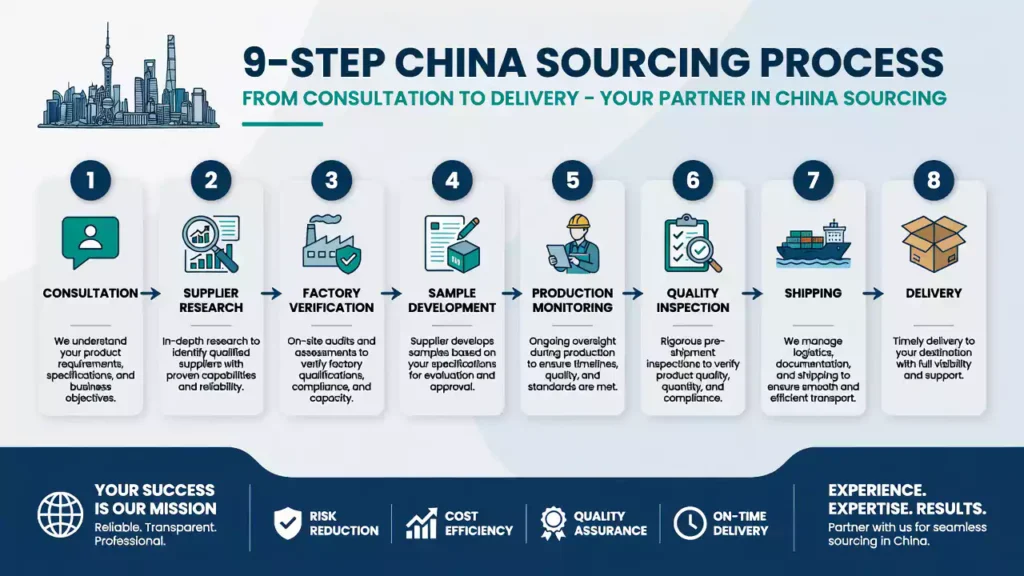
Step 1: Initial Consultation
We learn about:
- Product requirements
- Target market
- Budget
- Quality expectations
Step 2: Supplier Research
Our sourcing team identifies qualified manufacturers from our network and market research.
Step 3: Factory Verification
We verify:
- Business licenses
- Production capability
- Certifications
- Quality systems
Step 4: Supplier Comparison
We compare:
- Pricing
- MOQs
- Lead times
- Quality performance
Step 5: Sample Development
Samples are evaluated before mass production.
Step 6: Production Monitoring
We maintain communication with factories throughout production.
Step 7: Quality Inspection
Inspection checkpoints help prevent costly mistakes.
Typical inspections include the following:
- Pre-production inspection
- During-production inspection
- Final random inspection
Step 8: Shipping Coordination
We coordinate:
- Freight forwarding
- Export documents
- Delivery scheduling
Step 9: Post-Delivery Support
Our work doesn’t end when products leave China.
We continue supporting clients through delivery and future purchasing cycles.
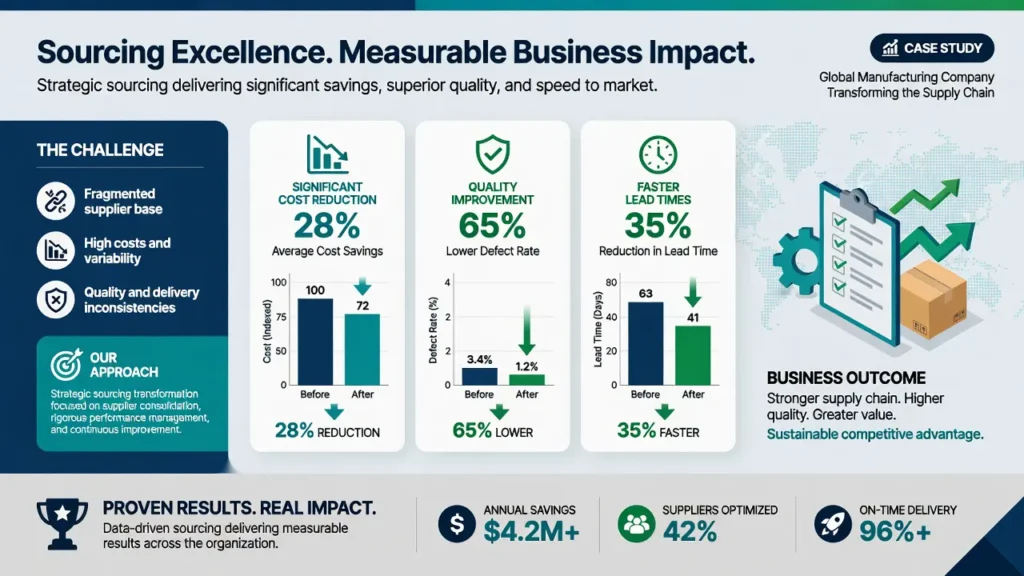
Real Client Results
Case Study #1 – Amazon Seller
Product Category: Home & Kitchen
Challenges:
- High defect rates
- Rising costs
Results:
- 22% cost reduction
- Defect rate below 2%
- Improved packaging quality
Case Study #2 – Wholesale Distributor
Product Category: Consumer Goods
Challenges:
- Supplier inconsistency
Results:
- Reliable manufacturing partner
- Faster lead times
- Stronger inventory planning
Case Study #3 – Startup Brand
Product Category: Custom Products
Challenges:
- No sourcing experience
Results:
- Successful product launch
- Production scalability
- Long-term supplier partnership
Frequently Asked Questions
1. What does a China sourcing agent do?
A sourcing agent helps buyers find the suppliers, negotiate pricing, manage production, inspect quality, and coordinate logistics.
2. How much does a sourcing agent cost?
Most agents charge either a commission, fixed project fee, or monthly retainer depending on project complexity.
3. Can sourcing agents help with private labeling?
Yes. Many agents support custom branding, packaging, and product development.
4. How do I know if a supplier is legitimate?
A sourcing agent can verify licenses, conduct audits, and inspect facilities.
5. Do I need a sourcing agent if I use Alibaba?
Yes. Alibaba is a platform, not a verification service. Independent supplier validation remains important.
6. Can sourcing agents negotiate better pricing?
Often yes. Experienced agents understand local pricing structures and negotiation practices.
7. What industries can sourcing agents support?
Common industries include:
- Consumer products
- Electronics
- Home goods
- Industrial products
- Promotional items
8. How long does sourcing usually take?
Supplier identification often takes 1–3 weeks, depending on complexity and customization requirements.
Conclusion
Finding the best China sourcing agent in 2026 is not about choosing the cheapest option.
It’s about selecting a trustworthy partner with proven experience, transparent pricing, strong supplier relationships, and reliable quality control processes.
Before making a decision, use the 10-point checklist outlined in this guide to evaluate every sourcing company you consider.
A trusted sourcing partner can help you:
- Reduce purchasing costs
- Improve product quality
- Avoid supplier risks
- Scale your business faster
- Build a more reliable supply chain
At Yinhan Sourcing, we’ve helped businesses worldwide source products safely and efficiently from China.
Whether you’re launching your first product or managing large-scale imports, our team is ready to help.
Book Your Free Consultation with Yinhan Sourcing
Are you ready to source smarter from China?
Contact Yinhan Sourcing today for a free consultation and discover how we can help you find reliable suppliers, reduce costs, and grow your business with confidence.
Trade Data
Logistics & Supply Chain Data