By Yingying · Founder & CEO, Yinhan Sourcing · Shenzhen, China
Starting your first import from China can feel like learning a new language while negotiating your biggest purchase of the year. This hub page gives you a clear path from product brief to delivery, shows where a sourcing agent fits, outlines the key costs and decisions, and flags the risks to control before you send a deposit. Where you might want more depth, we link to focused guides instead of repeating everything here.
What this page covers
- Who’s who: sourcing agents vs trading companies vs factories, and when each makes sense
- The end-to-end journey from product brief to delivery (overview)
- Step-by-step sourcing process
- Fees, retainers, commissions, and budgeting for total landed cost
- What China sourcing agents really cost
- Our pricing and scope
- Decision framework: do you need an agent for your first order?
- First-order checklist you can use immediately
- Risk control: what to verify before signing and common red flags
- Verify a China sourcing agent
- Avoid bad suppliers and middlemen
- Quick FAQs to resolve common uncertainties
Note on variability: Product pricing, lead times, MOQs, and service fees depend on your product, scope, order value, destination, and date. Regulatory, customs, tax, testing, and certification requirements vary by destination and product; confirm them with the relevant authorities or a qualified professional.
Who does what: agent, trading company, and factory
Understanding roles and incentives helps you choose the right partner for your first order.
| Role | Works for | How they earn | Typical strengths | Typical limitations | Good fit when… |
| Sourcing agent | You (the buyer) | Disclosed commission, fixed fee, or retainer | Supplier search, verification, negotiation, production monitoring, independent quality control, freight coordination | Requires clear scope; quality depends on the individual firm | You want transparency, multiple supplier options, and on-the-ground oversight |
| Trading company | Themselves (reseller) | Margin between factory price and your price | Quick quotes, smaller MOQs in some categories, can bundle products | Less price transparency; may limit factory access; customization can be narrower | You need small mixed orders or a category specialist who stocks |
| Factory (manufacturer) | Themselves (seller) | Ex-works or FOB price of what they produce | Technical know-how for their processes, best control for customizations within their capability | Sales bias toward their own lines; limited sourcing outside their scope | You know the exact factory and can manage verification, QC, and logistics |
Key takeaway for first-time importers: if you value supplier options, independent verification, and structured quality control, a buyer-side sourcing agent is often the most balanced starting point. For a side-by-side comparison of the three models and which one you are actually paying, see our guide on Chinese sourcing agents vs. sourcing companies.
Why a sourcing agent matters for first orders
For beginners, results typically hinge on three levers: time, risk, and money.
Time: An agent compresses weeks of supplier search, quoting, and sampling into a structured sprint and works across China’s time zones while you sleep. Risk: Genuine verification (business license checks, factory audits, and pre-shipment inspections) replaces guesswork, so you avoid sending deposits to intermediaries you did not intend to hire or approving uninspected goods. Money: Side-by-side quotations, realistic MOQs, and clear Incoterms reduce hidden costs. Experienced negotiation can return more value than the agent’s fee, particularly when payment terms, packaging, and tooling are involved.
Avoid bad suppliers and middlemen
The sourcing journey at a glance (from brief to delivery)
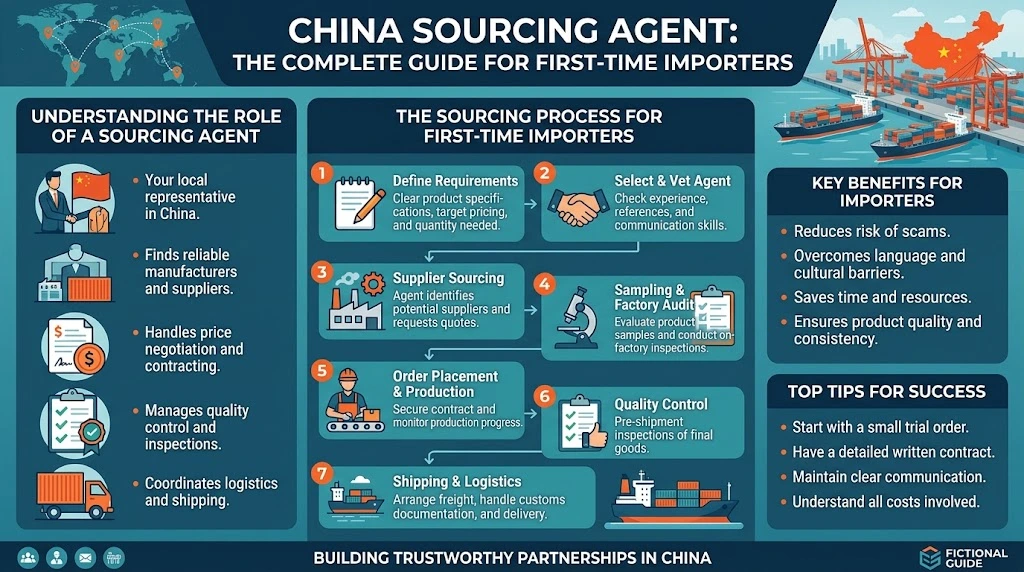
This is the typical path your first order follows. Use it to set expectations and align timelines. For a deeper dive into documents and timing, see the step-by-step process.
Product brief. Define specifications, materials, functions, dimensions, finish, packaging, target price range, certifications needed for your destination, and realistic order quantity.
Supplier search and shortlisting. Screen manufacturers from multiple sources (industry networks, Alibaba/1688, Made‑in‑China, Global Sources) and filter trading companies if you prefer direct factories.
Quotations and comparison. Standardize quotes to comparable terms (e.g., all on FOB), including MOQs, unit price, tooling, packaging, and lead time.
Samples. Order, consolidate, review samples; iterate until the “golden sample” aligns with your spec.
Negotiation and terms. Align on price, payment terms, lead time, packaging, labeling, and defect thresholds.
Order placement and documentation. Issue a purchase order. Where appropriate, sign a supplier agreement covering specs, timelines, quality standards, IP, and corrective actions.
Production monitoring. Confirm raw materials, start-of-line checks, and milestone updates to mitigate delays.
Quality control and inspection. In-line, pre-shipment, and carton drop tests as needed. Approve shipment based on reports and remedial actions.
Freight and export. Book with a freight forwarder under agreed Incoterms (e.g., EXW, FOB, CIF). Prepare export docs; coordinate with customs brokers at destination.
Delivery and feedback. Receive goods, check inbound quality, and log improvements for the next order.
At Yinhan Sourcing, our process is built around these milestones: we request a structured product brief, source and verify factories, provide a side-by-side quote sheet, manage sample consolidation, negotiate terms you’ve approved, place the PO, monitor production with dated checkpoints, arrange third-party or in-house inspections with photo reports, and coordinate with your freight forwarder or ours under your chosen Incoterms. If you want an overview of our scope and deliverables, see Our pricing and scope.
Do you need a sourcing agent? A practical decision framework
Use the following prompts to decide the right path for your first order.
Product complexity. Complex, customized, or safety-regulated items: favor a sourcing agent plus third‑party testing. Simple, commoditized SKUs: consider a trading company (for small mixed orders) or direct factory if you can manage QC and shipping.
Order value and frequency. One-off, low value: fixed-fee tasks (verification, inspection) may suffice. Ongoing orders: a commission or retainer model with a sourcing agent can spread overhead and build supplier leverage.
Risk tolerance. Low tolerance: hire an agent to run verification and inspections before paying balances. Higher tolerance and time to learn: DIY with targeted third‑party services for audits and QC.
Compliance burden. If destination regulations require testing or certification (e.g., for electronics, toys, cosmetics), engage support early to plan lead times and costs.
Time and language constraints. If you cannot work China business hours or read technical documents in Chinese, an agent is a sensible bridge.
If you lean toward “agent,” shortlist two or three, compare scope and compensation models, and ask for sample documents (quote templates, inspection reports, factory-check procedures).
Fees, retainers, commissions, and your real budget
Fee models vary by product, scope, order value, and market conditions. Clarify compensation up front and confirm there are no supplier‑side commissions that could distort advice.
| Fee model | How you pay | Best suited to | Keep in mind |
| Commission (%) | Percentage of total order value | First orders; small to mid-size buyers who want end-to-end help | Confirm commission is disclosed and not embedded in inflated supplier prices |
| Fixed fee | Set amount per order or per task (e.g., factory audit, inspection) | Large orders; defined tasks; one-off verifications | Scope creep can raise cost; define deliverables clearly |
| Retainer | Recurring monthly fee for ongoing procurement support | Ongoing, multi-SKU purchasing; brands building a category | Ensure monthly activity plans and measurable outputs |
Beyond service fees, budget for the full trade picture. Actual amounts vary widely by product, mode, and destination:
Samples and sample shipping (often not refundable), Tooling or molds (if customization requires it), Factory audits and inspection fees, Freight (inland trucking, ocean/air), insurance, Port and handling charges, Customs duties, VAT/GST, import taxes at destination, Compliance testing and certifications required by your market, Labeling, packaging, barcodes, Banking and currency conversion fees, and Domestic delivery from port to warehouse.
Tip: Standardize supplier quotations to the same Incoterm (e.g., all on FOB) to compare apples to apples.
What China sourcing agents really cost
Reference: Incoterms definitions are maintained by the International Chamber of Commerce. See the ICC’s summary for authoritative terms and responsibilities.
Landed cost basics (so you can price your product)
A simple way to frame your landed cost per unit (illustrative only; actuals vary by product and route):
Product cost on your chosen term (EXW or FOB)
+ Origin charges not included in that term (e.g., export docs, trucking to port if buying EXW)
+ International freight and insurance
+ Destination port, customs clearance, duties, and taxes
+ Compliance testing and certification where required
+ Inspections and any rework or repacking
+ Final delivery to your warehouse
= Estimated landed cost per unit
Important cautions:
Duties and taxes depend on HS classification, declared value, and country of import. Use your customs broker for binding advice. Required testing and certifications (for example, electrical safety, REACH, CPSIA, food-contact) depend on your product and destination; plan cost and time early. Incoterms allocate cost and risk between buyer and seller; they do not control transfer of title or payment terms. See the ICC Incoterms resource in References.
What to verify before you sign (risk control essentials)
Shortlist in hand, confirm the following before you send any deposit:
- Compensation and conflicts
- Written disclosure of how the agent is paid; confirmation of no supplier-side commissions unless explicitly agreed.
- Supplier transparency
- Whether the agent will disclose factory names, addresses, and licenses once shortlisted; who owns the supplier relationship after the project.
- Scope and deliverables
- Exactly which tasks are included (search, verification, sampling, negotiation, production monitoring, inspections, logistics coordination) and which are not.
- Documentation
- Use of purchase orders, a supplier agreement when appropriate, and inspection checklists tailored to your product.
- Verification depth
- Business license checks, onsite or remote audits as needed, and sample of a real inspection report you will receive.
- Quality control rights
- Clear right to conduct in-line and pre-shipment inspections, acceptance criteria, and corrective-action process if defects are found.
- Payments and accounts
- Who you pay (legal entity name), when (deposit/balance split), and how (bank details). Avoid wiring to personal accounts. Consider escrow where feasible.
- IP and packaging
- Ownership of designs, tooling, and brand assets; artwork approval flows; labeling to meet destination rules.
- Data and confidentiality
- NDA terms and who may access your product drawings and pricing.
- Termination and handover
- How either party can exit, and how supplier files and QA records are handed over.
Red flags for beginners:
- Vague fees or reluctance to disclose how they earn
- No factory verification beyond forwarding online listings
- Pressure to forgo inspection “to save time”
- Requests for 100% payment up front to personal accounts
- Unwillingness to show a template inspection report or a factory audit checklist
Avoid bad suppliers and middlemen
Shipping and Incoterms in brief
Choose Incoterms that match your risk appetite and logistics capability:
EXW (Ex Works): You arrange pickup from the factory, all export and onward logistics. High control, high responsibility. FOB (Free On Board): Supplier gets goods onto the vessel at the named port; you control the main freight and beyond. Common for first orders with an independent forwarder. CIF/CFR (Cost, Insurance and Freight / Cost and Freight): Supplier books main carriage. You still handle customs clearance and local delivery.
Practical notes:
Many first-time importers choose FOB to keep transparency on main freight while limiting origin risk. If you accept supplier-arranged freight (CIF/CFR), confirm what is and is not included and who handles destination charges. Use a reputable freight forwarder and a licensed customs broker in your destination market.
Reference: See the ICC overview for precise definitions of Incoterms 2020.
Additional reading: The WTO Trade Facilitation Agreement offers context on cross-border clearance practices.
Illustrative example: a first private-label order
Illustrative example: A small home-and-kitchen brand wants a customized stainless steel water bottle with retail packaging.
The buyer prepares a brief with sizes, material grade, color finish, packaging dieline, and target order quantity. The agent screens factories in Zhejiang and Guangdong making stainless drinkware, verifies licenses, and narrows to three. Quotes are standardized on FOB Ningbo with MOQs, unit prices, lead times, and optional add-ons (laser etching vs. color print). Samples from all three are consolidated; the buyer selects a golden sample and approves pantone colors. The agent negotiates a staged payment (deposit/balance), confirms a realistic lead time, and includes a carton drop test and AQL thresholds in the PO. During production, the agent verifies material certificates and spot-checks finish consistency. A pre-shipment inspection flags misaligned printing on 7% of units; rework is completed and rechecked. Freight is booked FOB; the buyer’s forwarder clears customs and delivers to the 3PL.
Outcome: The first order ships within the planned window, and the team logs specific improvements for the second run (extra jig for print alignment, updated carton labels).
First-order checklist (use before you send a deposit)
Product and compliance
- Finalized spec sheet and drawings; packaging and labeling requirements confirmed
- Destination compliance mapped (testing, certifications, labeling) with lead-time impact
- Agreed MOQs and any price impact of a smaller first order
Supplier and verification
- Shortlist of genuine factories with business license details
- At least one sample that matches your spec; golden sample signed/dated
- Verification level agreed (remote check, onsite audit) with deliverables
Commercial terms
- Side-by-side quotation sheet on a common Incoterm (e.g., FOB)
- Negotiated payment terms, lead time, and defect thresholds (AQL or similar)
- Purchase order issued; supplier agreement used where appropriate
Quality and logistics
- Inspection plan (in-line and pre-shipment) and acceptance criteria
- Freight plan and forwarder engaged; Incoterms, HS code, and packing specs confirmed
- Importer customs broker briefed; estimated duties/taxes understood
Governance
- Agent’s compensation method documented; no supplier-side commissions unless disclosed
- Bank details verified; staged payments aligned to milestones
- NDA in place if sharing drawings or brand assets
Common questions (quick answers)
What does a China sourcing agent actually do?
They act on your behalf to find, verify, and buy from suitable manufacturers. Typical tasks include supplier search, quotation and comparison, sampling, negotiation, production monitoring, inspection, and freight coordination.
Is a sourcing agent different from a trading company?
Yes. A sourcing agent works for you and is paid a disclosed fee or commission. A trading company buys from factories and resells to you at a margin. Each can be useful depending on your needs for transparency, MOQ, and speed.
How much does a sourcing agent cost?
Pricing depends on fee model (commission, fixed-fee, retainer), your product, and scope. Budget separately for samples, audits/inspections, freight, insurance, duties/taxes, and any required testing or certification.
What China sourcing agents really cost
Can an agent help with testing and certifications?
They can coordinate labs and timelines, but regulatory responsibility rests with the importer. Requirements vary by destination and product; confirm with your compliance advisor or local authority.
Which Incoterm should I choose for a first order?
Many beginners use FOB to control main freight while limiting origin risk. Choose based on your logistics capability. Review the ICC’s Incoterms definitions and consult a forwarder or broker.
How do I verify that a supplier is a real factory?
Check licenses and scope, request photos or video of production lines, conduct audits where appropriate, and require pre-shipment inspection.
Avoid bad suppliers and middlemen
What if I only need help with one task?
You can hire per-task support such as factory audits, inspections, or sample consolidation under a fixed-fee scope.
How fast can I place a first order?
Timelines vary. The gating factors are sample iterations, verification depth, lead time, and any required compliance testing. Build contingency for revisions and inspections.
Where to go next
If you want a deeper walkthrough of documents and milestones: Step-by-step sourcing process, If you are comparing compensation models and line items: What China sourcing agents really cost and Our pricing and scope, If you are validating partners: Verify a China sourcing agent and Avoid bad suppliers and middlemen, and If you want to understand how we work as a company: About Yinhan Sourcing.
At Yinhan Sourcing, our process focuses on supplier verification, structured comparison, quality control, and clear handoffs with freight partners. If you would like help with your first order—from brief to delivery—feel free to get in touch. Contact us for an initial discussion.
Editorial note: This guide is educational information, not legal, customs, tax, financial, or product-compliance advice. Requirements vary by destination and product; verify them with the relevant authorities or a qualified professional.