By Yingying · Founder & CEO, Yinhan Sourcing · Shenzhen, China
How to use this guide
Primary job: help you build a phase-based cost model for a China sourcing engagement so you budget beyond the agent’s commission. This page separates agent compensation from third‑party and contingent costs (samples, audits, inspections, testing, tooling, freight, insurance, duties, taxes, banking, storage, and rework), and shows when each tends to appear. Requirements and pricing vary by product, order size, destination, Incoterms, and date. Use the table and checklist to map your own numbers before you sign.
If you need fee models: What sourcing agents charge, If you need steps and deliverables: Step‑by‑step sourcing process, and If you are shortlisting partners: How to verify a China sourcing agent.
Why the “hidden” part matters
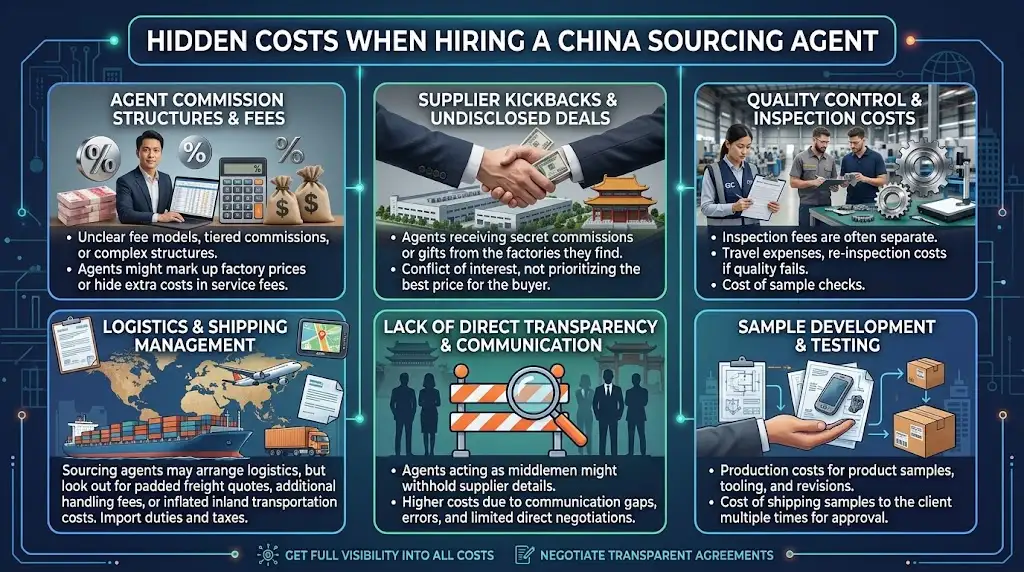
An agent’s 5% or 8% rate is only their compensation. Your total procurement cost also includes verification, samples, laboratory tests, tooling, inspections, payment friction, freight/insurance, customs, taxes, storage, and—if something goes off‑plan—rework and re‑inspection. The items that surprise buyers are often the contingent ones (e.g., re‑inspection after a fail, partial air freight after a delay), because they do not appear until late in the order.
The antidote is to price each phase before you reach it, and to write down which costs are inside the agent’s fee and which are paid separately to third parties.
Cost taxonomy at a glance (by phase)
The ranges below are illustrative planning bands to help you frame a budget. Actuals vary by product complexity, category regulation, geography, season, and market rates at the time you buy.
| Phase | Cost bucket (separate from agent compensation) | Who is paid | Typical trigger | Illustrative range | How to pre‑empt surprises |
| Pre‑engagement | Supplier database pull, basic verification, scoping calls | Usually included; if external, a verifier | Before signing | Often included; external checks vary | Ask for a scope map showing “inside” vs “outside” fee lines |
| Shortlist & validation | Factory audit (on‑site/remote), background checks | Third‑party auditor or agent’s audit team | Before first order | A common band is a few hundred USD per site | Fix audit scope, deliverables, and pricing in writing |
| Samples | Sample build, domestic courier, international courier | Factory and couriers | During evaluation and approvals | Small to mid hundreds per round, depending on weight/speed | Set a sample budget cap and approval threshold |
| Engineering & tooling | DFM review, molds/dies/jigs, fixtures, packaging dies | Factory or toolmaker | Before production | Hundreds to several thousand+ USD | Contract cost, ownership, life, maintenance, and transfer terms |
| Payments | Bank wires, platform fees, FX spread | Banks or payment platforms | Each deposit/balance | Often a % spread plus per‑transfer fees | Compare methods and set the payment plan up front |
| Production follow‑up | In‑line inspection, on‑site monitoring | Inspection firm/agent | Mid‑production | Day‑rate plus travel | Decide risk‑based need and scope; document it |
| QC & compliance | Pre‑shipment inspection, re‑inspection, lab tests | Inspectors, labs | Before shipment | Inspection: hundreds; tests: widely variable by standard | Tie inspection to AQL; confirm required tests for destination |
| Freight & insurance | Ocean/air, surcharges, insurance | Freight forwarder/insurer | Post‑balance, at booking | Market‑driven; can swing significantly | Choose Incoterms carefully; hold a buffer for seasonality |
| Import & delivery | Brokerage, duties/taxes, port fees, ISF/AMS, inland | Broker, carriers, authorities | Arrival at destination | Tariff- and route-dependent | Pre‑model HS code, duty rate, and last‑mile path |
| Post‑arrival | Storage, demurrage/detention, rework, disposal | Warehouse/3PL/repair provider | If delays/defects occur | Daily/transactional fees | Lock service levels; plan fallback rework criteria |
| Reorder & lifecycle | Tooling wear, price drift, currency movement | Factory/tools, banks | Future cycles | Repeats of earlier lines | Build amortization and currency policies into contracts |
Note on variability: duties, taxes, product testing, and certification are destination- and product‑specific. Confirm with a competent customs broker or regulatory specialist in your market before you commit.
Separate the two conversations: agent compensation vs. everything else
Importers get cleaner outcomes when they negotiate two distinct scopes:
1) Agent compensation (what you pay the agent)
Common structures: commission (a percentage), fixed per project, monthly retainer, or per‑task fees. Clarify the base: Is a percentage calculated on EXW factory price, FOB value, or total invoice (including tooling, samples, and inland)? The base changes the math materially. Define deliverables tied to compensation: number of qualified suppliers, negotiation rounds, document control, production follow‑up cadence, inspection coordination, reporting format.
2) Third‑party and pass‑through costs (what you pay others)
Verification, audits, samples/couriers, tooling, inspections, lab tests, freight/insurance, brokerage/duties/taxes, banking, and any rework/storage. Decide who arranges (you, the agent, or named vendors), how approvals work, and when estimates convert to POs.
At Yinhan Sourcing, our process for cost transparency is to provide a line‑item pro‑forma before engagement showing compensation base and all expected third‑party lines, each labeled as “inside” or “outside” the agent fee, with assumptions and approval thresholds. This is our standard—buyers should expect the same clarity from any professional partner.
Phase-by-phase: where hidden costs typically enter
Phase 1: Pre‑engagement: define inside vs. outside
Write down whether the quoted fee includes or excludes: factory audit, pre‑shipment inspection, in‑line inspection, laboratory testing, sample builds, courier legs, tooling coordination, and document costs (e.g., certificate of origin, legalization if required). Ask for a written conflict‑of‑interest statement on supplier rebates/commissions. Undisclosed factory rebates shift economics on every unit.
Decision prompt:
If a cost is “outside,” obtain an estimate with scope and a basis (e.g., per inspector day, per test method, per kilogram courier at a named service level).
Phase 2: Supplier search and verification
Factory audit scope drives cost and risk. A documented audit—license and Unified Social Credit Code check, registered scope, equipment list, photographed lines, capacity estimate, basic process flow, and social/environmental red‑flags—costs more than an informal visit but reduces expensive surprises later. Sampling can stack: product, packaging, color standards, and revised iterations. Couriers across multiple rounds can exceed the build cost.
Practical moves:
Cap sample spending per round and total; require written approval above a threshold. Keep a retained “golden sample” and color standards (e.g., Pantone) with signatures.
Phase 3: Engineering, DFM, and tooling
Tooling is a capital item. Clarify five points in one document before you commission:
1) Exact cost and payment schedule
2) Ownership (including the right to remove the tool)
3) Expected life (shots/cycles) and maintenance responsibility
4) Storage and insurance when idle
5) Replacement, wear‑out, and discontinuation terms
If the tool is at a sub‑supplier, document its location and control.
Common oversights:
Ambiguous ownership (factory assumes ownership even if you paid). Missing life data (you discover wear‑out at reorder time).
Phase 4: Order placement and payments
Payment friction includes sending and receiving bank fees and an exchange‑rate spread. Platform alternatives (e.g., specialized FX providers) can reduce total cost for certain currency pairs and values; compare effective rates and fixed fees. Incoterms matter early. EXW shifts inland China costs and export clearance to you; FOB places those with the seller. Choose deliberately.
Actions:
Confirm the exact beneficiary name, bank, and currency. Lock quotation currency and validity period to reduce FX surprises. For larger orders, consult on hedging or staged conversions if policy permits.
Reference: ICC Incoterms explain cost/risk allocations (see References).
Phase 5: Production follow‑up
Skipping in‑line checks converts early fixable issues into late expensive ones. If your product has tight tolerances, safety‑critical elements, or complex decoration/assembly, plan at least one mid‑production check. Some factories charge for rush changes, overtime, or reslotting a line if specs shift mid‑run.
Risk control:
Time and scope your in‑line inspection to the stage when defects first appear (e.g., after first shots, after first assembly, before sealing cartons).
Phase 6: Quality control and compliance
Pre‑shipment inspection: align on AQL levels, sampling plan, defect classification, and photo/video reporting. A “walk‑through” is not the same service as an AQL‑based inspection. Re‑inspection: if the first inspection fails and rework is needed, a second inspection is often a separate charge, regardless of fault allocation. Agree upfront how re‑inspection fees are handled. Laboratory testing: regulatory, safety, and performance tests vary by destination and product (for example, food‑contact, children’s products, textiles, batteries, or electrical goods often require named standards). Confirm which standards apply in your destination before you produce.
Tip:
Budget a contingency line for one re‑inspection per order. If unused, it drops to margin.
Phase 7: Freight and cargo insurance
Freight markets move with seasonality, surcharges, and events; budget buffers accordingly. Common add‑ons include fuel, peak season, congestion, and security/war‑risk surcharges. Air vs. ocean differentials become material if timelines slip. A partial airfreight “gap‑fill” for launch coverage can cost more than all prior verification combined. Insurance is optional but important. Understand Institute Cargo Clauses, declared value, exclusions, and deductibles.
Incoterms alignment:
Under FOB, your forwarder takes control at the named port; under CIF/CFR the seller books main‑carriage but you still handle destination charges. Choose based on your control preference and forwarder relationships.
Phase 8: Customs, duties, taxes, and last‑mile
Duty rates depend on HS classification and country of origin; taxes (e.g., VAT/GST) and fees (e.g., customs processing, merchandise processing, ISF/AMS filings in the U.S.) vary by destination. Destination charges can include terminal handling, deconsolidation, chassis, storage, and appointment fees (e.g., for FBA deliveries). Regulatory and product‑safety requirements are destination‑specific. Some products also face Extended Producer Responsibility (EPR) packaging or recycling fees in certain markets.
Action items:
Pre‑classify your product with a broker, model landed cost per unit including duty/tax, and book a delivery slot with your 3PL to avoid storage or missed appointments.
Phase 9: Post‑arrival realities and reorders
Storage and dwell charges (demurrage/detention at port, warehouse storage in 3PL) escalate quickly if documents are late, inspections take longer than planned, or delivery appointments slip. Rework can be necessary at destination for labeling, packaging, kitting, or defect remediation; those labor and material costs should be priced in as a contingency when quality risk is non‑trivial. Lifecycle: tooling maintenance or replacement, component obsolescence, MOQ drift, and exchange‑rate shifts can alter reorder economics. Capture these in a rolling forecast.
Illustrative example: how contingency costs overtake the commission
A brand commissions 5,000 custom stainless tumblers with a sourcing agent at 6% on an order around USD 22,000. The visible agent fee is USD 1,320. The following line items appear:
Tooling for a custom mold: a mid‑hundreds USD outlay. Ownership terms were not documented; later, shifting production becomes difficult without repurchasing or negotiating tool transfer. Payment friction across three installments: per‑transfer bank fees and an exchange‑rate spread that together add a mid‑hundreds USD cost. Re‑inspection after a pre‑shipment fail on logo alignment: an additional inspection fee in the low‑hundreds USD range. Partial airfreight to meet a launch date after rework delayed the sailing: a low thousands USD uplift vs. the ocean‑only plan.
Illustrative takeaway: even with an ordinary agent rate, late‑stage contingencies and pass‑throughs can exceed the commission. The solution is not a lower rate; it is a complete pre‑engagement cost map with contingencies and decision triggers.
Red flags and green lights in cost disclosure
Red flag: Bundled “all‑in” quotes with no line items for audit, inspection, testing, samples, tooling, or freight coordination. Green light: a breakdown with calculation bases and named deliverables. Red flag: Silence on tooling ownership, life, and transfer. Green light: a written clause covering cost, ownership, shot life, maintenance, storage, and return/removal rights. Red flag: Commission % without a base (EXW, FOB, total invoice). Green light: explicit base and what is excluded from it. Red flag: “Inspection included” without sampling plan, man‑days, or defect classification. Green light: AQL levels, sampling scope, and reporting formats defined. Red flag: No discussion of payment routing and FX. Green light: options, effective rate comparisons, and a recommended schedule for your order size. Red flag: No written statement on supplier‑side commissions/rebates. Green light: clear disclosure on conflicts and how they are handled.
What to verify before signing (risk‑control checklist)
Use this list as your pre‑engagement gate. Ask for documents or written answers to each point.
Scope and compensation
- Agent compensation structure, calculation base (EXW/FOB/total), and deliverables tied to it
- Named exclusions and which party arranges/pay for each third‑party item
Supplier and conflict checks
- Audit scope, template, and named audit provider (if third‑party)
- Written statement on factory rebates/commissions and conflict management
Sampling and specification control
- Sample budget ceiling and approval threshold
- Golden sample retention, color/finish standards, packaging dielines
Tooling control
- Tooling quotation + specification + ownership + life + maintenance + storage + transfer/removal clause in a single document
Quality and compliance
- In‑line and pre‑shipment inspection plan, AQL levels, re‑inspection policy and payer
- Applicable destination regulatory tests/certifications, named test methods, and who arranges
Payments and currency
- Beneficiary details, currency, expected fee/FX structure by installment, and quotation validity
- Policy for exchange‑rate movement on larger orders
Logistics and Incoterms
- Chosen Incoterm and its impact on inland China costs, export clearance, and insurance
- Freight quote assumptions, buffers for seasonality, and insurance coverage terms
Importation and delivery
- Preliminary HS classification, duty/tax modeling, broker contact
- Delivery appointment/requirements for your 3PL or marketplace (e.g., FBA)
Post‑arrival contingencies
- Storage/detention/demurrage responsibility and escalation points
- Rework criteria, authorization thresholds, and disposal policy for non‑conforming goods
Documentation and change control
- Versioned specification pack, ECN (engineering change notice) process, and sign‑off points
- Dispute resolution path and governing law/jurisdiction in contracts
A simple decision framework for landed cost modeling
Start with unit EXW price from the factory. Add agent compensation calculated on the stated base. Add: audits, samples + courier, tooling amortized per unit, inspections (incl. one re‑inspection contingency), regulatory tests, payment friction per installment, inland China legs (if EXW), main freight + insurance, destination charges + brokerage, duties/taxes, last‑mile delivery, storage buffer, and a defect/rework contingency in line with category risk. Divide total by projected received‑good units (net of expected defect scrap) for landed cost per unit. Test two scenarios: on‑plan and one delay/re‑inspection. If your margin breaks in the second, adjust spec, price, or timeline now.
How we handle transparency at Yinhan Sourcing
Company‑specific note: At Yinhan Sourcing, our process is to:
Issue a pre‑engagement cost map with “inside vs. outside” lines and assumptions, Disclose any supplier‑side compensation structure in writing, Package tooling cost + ownership + life + maintenance in one approval, Set sample and re‑inspection approval thresholds, Align on Incoterms and forwarder responsibility before POs, and Track actuals vs. estimates per phase and flag variances as they happen.
For a line‑item estimate on your product, you can request a quote. Get a quote or review our pricing structure. See pricing
How to verify a China sourcing agent
FAQ
What exactly counts as a “hidden” cost?
Any required spend to get goods landed that a reasonable buyer would not know to budget for from the headline agent fee alone. Typical examples: re‑inspection, payment fees, tooling replacement, partial airfreight after a delay, destination storage, and compliance testing that depends on your market.
Is it better to ask for an “all‑in” fee?
An all‑in number helps if it explicitly lists which third‑party items are included (e.g., one factory audit, one pre‑shipment inspection, specified tests) and which are excluded. A single unlabeled number just hides the lines you’ll pay later.
How big should my contingency be?
It depends on product and risk tolerance. Many importers model at least: one re‑inspection, a modest freight buffer for seasonality, and a small rework/destination storage buffer. Tooling replacement or additional tests are separate if your category is demanding.
If I pay for tooling, do I own it?
Ownership is determined by contract, not payment alone. In many sectors, the default is factory ownership unless a written clause says otherwise. Secure a tooling clause covering ownership, life, maintenance, storage, and transfer rights before commissioning.
Can my agent arrange inspections and tests?
Yes, many agents coordinate third‑parties. Clarify vendor selection, scope, deliverables, and that invoices identify third‑party charges separately from the agent’s compensation. Testing and certification requirements are destination‑ and product‑specific; verify with qualified professionals.
Do Incoterms affect hidden costs?
Yes. Incoterms define who pays/controls inland legs, export clearance, main carriage, insurance, and destination charges. Choose them deliberately. For clarity on responsibilities, consult authoritative Incoterms guidance (see References).
What about duties and taxes—can an agent estimate them?
Agents may provide directional estimates, but accurate duty/tax modeling is the role of a customs broker in your destination. Duty rates and compliance requirements vary by HS code and market; verify before you order.
How do I compare two agent quotes fairly?
Put them on a common template: compensation base and rate, included/excluded third‑party items, assumed audit/inspection/testing scopes, sample budgets, tooling with ownership terms, payment method/FX assumptions, and Incoterms. Then compare total expected landed cost, not just the percentage fee.