If you have ever tried to buy products from China on your own, you already know how quickly the process can become overwhelming. You send messages to a dozen suppliers, receive wildly different quotes, struggle to tell a real factory from a middleman, and worry whether the samples you approved will match the goods that eventually arrive at your door. This is exactly the problem a China sourcing agent is built to solve. So what is a China sourcing agent, in plain terms? It is a professional, based in or closely connected to China, who represents your interests as the buyer and manages the entire purchasing process on your behalf, from finding the right manufacturer to shipping finished goods out of the port.
In this guide we will define what a China sourcing agent actually does, explain why importers rely on one, walk through the step-by-step sourcing process, break down typical costs and fee structures, highlight the risks and red flags to watch for, and give you a practical checklist for choosing a trustworthy partner. Whether you are an Amazon FBA seller launching your first private label product or an established wholesaler expanding your supplier base, this article will help you decide whether working with a sourcing agent is the right move.
What Is a China Sourcing Agent?
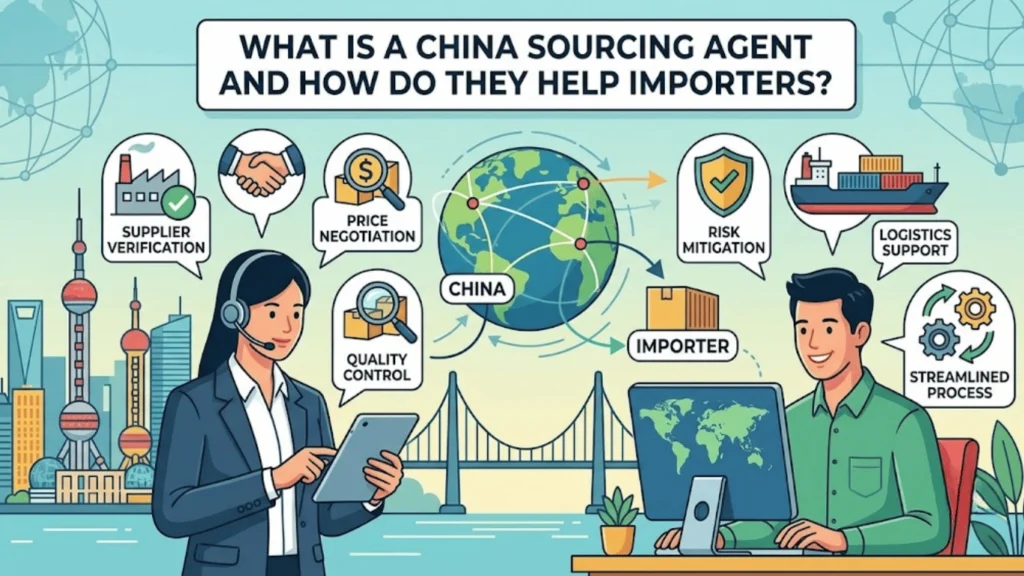
A China sourcing agent is an individual or company that helps importers find, evaluate, and buy products from Chinese manufacturers. Think of the agent as your eyes, ears, and negotiator on the ground. Instead of you emailing unknown suppliers across a twelve-hour time difference, the agent handles supplier search, supplier shortlisting, quotation gathering, sample checking, price negotiation, and quality control for you, usually in your own language and during your working relationship.
The key point that separates a good sourcing agent from other players is whose side they are on. A genuine sourcing agent works for the buyer. Their job is to get you the best combination of price, quality, and reliability. This is different from a trading company, which typically buys goods from a factory, marks them up, and resells them to you as if the products were their own. It is also different from a factory sales representative, who naturally wants to sell you their factory’s products, whether or not those products are the best fit.
A sourcing agent sits between you and the Chinese supply chain and coordinates procurement and purchasing so that you can focus on selling. Agents commonly operate out of major manufacturing and trading hubs such as Shenzhen, Guangzhou, Dongguan, Foshan, Ningbo, Shanghai, and Yiwu, which gives them physical access to factories and wholesale markets. Many also work fluently with sourcing platforms like Alibaba, 1688, Made-in-China, and Global Sources, and they understand the difference between what those platforms show online and what is actually happening inside a factory.
Why This Matters for Importers
For most importers, the appeal of a sourcing agent comes down to three things: saving time, reducing risk, and protecting margins.
Consider a first-time Amazon FBA seller who wants to launch a private label kitchen gadget. On their own, they might spend weeks messaging suppliers on Alibaba, only to discover after paying a deposit that their “factory” was actually a trading company adding a hidden markup, or that the supplier cannot meet the required minimum order quantity, or that the product failed inspection after it was already produced. Each of these mistakes costs money and, often worse, costs time in a market where getting to launch quickly matters.
A sourcing agent reduces these risks by verifying who you are actually dealing with before any money changes hands. Because they can visit factories, request business licenses, and conduct or arrange a factory audit, they turn a leap of faith into an informed decision. For a wholesaler placing large repeat orders, that verification and ongoing production monitoring can be the difference between a smooth supply chain and a warehouse full of defective stock.
There is also a communication and cultural dimension that is easy to underestimate. Negotiation in China often depends on relationships, clarity, and knowing what is normal versus what is a warning sign. An experienced agent knows when a price is genuinely competitive, when a lead time is realistic, and how to structure payment terms so that you are not exposed. For startups and small businesses without a procurement department, this expertise is like renting a purchasing team without the overhead of hiring one.
How the Process Works
While every agent works a little differently, a professional sourcing engagement usually follows a clear sequence. Understanding this process helps you know what to expect and what to ask for at each stage.
1. Product briefing and requirements. You tell the agent what you want to source, including specifications, target price, required certifications, packaging needs, and your ideal order quantity. The more detail you provide, the better the results. A good agent will ask clarifying questions rather than guessing.
2. Supplier search and shortlisting. The agent searches for suitable manufacturers using their own network plus platforms such as Alibaba, 1688, Made-in-China, and Global Sources. They filter out trading companies posing as factories and build a shortlist of genuine suppliers who can meet your specifications and minimum order quantity (MOQ).
3. Quotation comparison. The agent collects quotes from shortlisted suppliers and presents them side by side so you can compare unit price, MOQ, lead time, and terms on a like-for-like basis. Because a single supplier quoting alone has little pressure to sharpen a price, comparing several quotes usually improves your position.
4. Samples. Before committing to bulk production, the agent orders samples, inspects them, and often ships a consolidated batch to you. Sample checking catches material, sizing, and finish problems while they are still cheap to fix.
5. Negotiation. Once you choose a supplier, the agent negotiates price, payment terms, production timelines, and packaging. Skilled negotiation here often recovers more than the agent’s fee.
6. Order placement and follow-up. The agent helps formalize the deal with a purchase order and, ideally, a clear supplier contract that spells out specifications, quantities, delivery dates, and quality standards. During production, the agent handles production monitoring and keeps you updated on progress.
7. Quality control and inspection. Before goods leave the factory, the agent arranges quality control, which may include an in-line check during production and a pre-shipment inspection. You receive an inspection report with photos so you can approve shipment with confidence.
8. Shipping coordination. Finally, the agent coordinates with a freight forwarder to arrange shipping under the agreed Incoterms and helps prepare documents for customs clearance. Whether you buy EXW, FOB, or CIF affects who is responsible for what along the way, and a good agent will explain the trade-offs.
To make this concrete, imagine a private label brand ordering reusable water bottles. The agent shortlists three real factories in Ningbo, gathers quotes, orders one sample from each, helps the brand pick the best build quality, negotiates a lower MOQ for the first order, monitors production, arranges a pre-shipment inspection that catches a lid defect on a small share of units, has it corrected, and then books FOB Ningbo shipping with a trusted freight forwarder. That is the full arc of what a sourcing agent does.
Costs, Fees, and Budget Factors
One of the most common questions importers ask is how much a China sourcing agent costs. There is no single answer, because agents use different fee models depending on the size and complexity of your order. The three most common structures are commission, fixed fee, and retainer.
A commission model means the agent charges a percentage of your total order value, commonly in the range of a few percent up to around ten percent depending on the product and workload. This model works well for buyers who want the agent’s incentives tied to getting the order placed, though you should confirm the commission is charged transparently and not hidden inside inflated supplier prices.
A fixed-fee model means you pay a set amount per project or per order regardless of order value. This can be attractive for large orders, where a percentage commission would be expensive, or for well-defined tasks such as a single factory audit or inspection.
A retainer model means you pay a recurring monthly fee for ongoing sourcing support. This suits established importers with continuous purchasing needs who effectively want a dedicated procurement partner.
Beyond the agent’s own fee, budget for the real costs of doing business: sample costs and sample shipping, inspection and factory audit fees, freight and insurance, duties and taxes at customs clearance, and any product testing or certification you require. The table below compares the common fee models so you can see which fits your situation.
| Fee Model | How It Works | Best For | Watch Out For |
| Commission (%) | A percentage of total order value | First orders, small- to mid-size buyers | Hidden markups added on top of supplier prices |
| Fixed fee | A set price per order or per task | Large orders, one-off audits, or inspections | Scope creep beyond the agreed task |
| Retainer | A recurring monthly fee | High-volume, ongoing sourcing needs | Paying during months with little activity |
The cheapest agent is rarely the best value. A slightly higher fee that comes with real factory verification, honest negotiation, and reliable quality control usually saves far more than it costs by preventing defective shipments and failed orders.
Risks and Red Flags
Not everyone offering sourcing services deserves your trust. Because the industry has a low barrier to entry, importers should know the warning signs before handing over money or supplier details.
The most damaging risk is a hidden supplier commission. Some so-called agents secretly take a kickback from the factory in addition to charging you, which quietly inflates your unit price and destroys the neutrality you are paying for. A trustworthy agent is transparent about exactly how they are paid and by whom.
Watch for fake or inexperienced agents who cannot prove factory access. If someone claims to work with hundreds of factories but cannot walk you through a specific verification process, cannot share a real inspection report, or is reluctant to visit a supplier in person, treat that as a serious red flag.
Poor supplier verification is another common failure. An agent who simply forwards Alibaba listings without confirming the business license, checking whether the supplier is a factory or a trading company, or conducting a factory audit is not adding much protection. The whole point of an agent is verification.
Be cautious about unclear payment terms. You should understand who you are paying, when, and for what. Requests to send full payment upfront to a personal account, vague deposit structures, or pressure to skip a formal purchase order and supplier contract all deserve scrutiny.
Finally, be wary of any agent who discourages inspection reports or independent quality control. A reputable partner welcomes inspection because it protects everyone. Reluctance to inspect often signals a relationship that is too cozy with the factory and not cozy enough with you.
Buyer Checklist: Vetting a China Sourcing Agent
Use the following checklist before you commit to any sourcing agent. If you cannot get clear answers to most of these points, keep looking.
- Can they clearly explain how they are paid, with no hidden supplier commissions?
- Will they provide references from importers in your product category?
- Can they distinguish a real manufacturer from a trading company and prove it?
- Are they willing to conduct or arrange a factory audit and share the results?
- Do they provide side-by-side quotation comparisons rather than a single quote?
- Will they order and inspect samples before bulk production?
- Do they issue a written purchase order and supplier contract with clear specifications?
- Do they provide pre-shipment inspection reports with photos?
- Can they coordinate a freight forwarder and explain Incoterms such as EXW, FOB, and CIF?
- Do they communicate promptly and in clear language during your time zone’s working hours?
How to Choose the Right Partner
Choosing a China sourcing agent is ultimately a decision about trust, and trust should be based on evidence rather than promises. Start with experience in your specific product category. An agent who has sourced electronics in Shenzhen may not be the right fit for textiles, and someone who knows the Yiwu wholesale market inside out may be perfect for small commodity goods but less suited to complex machinery.
Prioritize transparency above almost everything else. The best agents are open about their fees, their supplier relationships, and the realistic trade-offs of your order. If an agent tells you honestly that your target price is unrealistic or that a lower MOQ will cost more per unit, that candor is a good sign, not a bad one.
Look for strong documentation habits. Professional agents work with purchase orders, supplier contracts, clear payment terms, and inspection reports as a matter of routine. Documentation protects you if something goes wrong and shows that the agent takes procurement seriously.
Evaluate communication. Sourcing involves constant back-and-forth, and delays or vague answers early in the relationship tend to get worse under the pressure of a live order. You want a partner who responds clearly, flags problems early, and keeps you informed during production monitoring.
Finally, insist on proof of factory access. Photos from inside factories, real audit findings, and a willingness to visit suppliers in person separate genuine agents from those who merely resell online listings. When experience, transparency, documentation, communication, and proven factory access line up, you have found a partner worth building a long-term relationship with.
Frequently Asked Questions
What is a China sourcing agent?
A China sourcing agent is a professional or company that represents importers to find, verify, and buy products from Chinese manufacturers. They handle supplier search, negotiation, sample checking, quality control, and shipping coordination so that the buyer does not have to manage the Chinese supply chain alone.
How does a China sourcing agent work?
The agent takes your product requirements, searches for and shortlists genuine suppliers, gathers and compares quotations, arranges samples, negotiates price and terms, oversees production, conducts or arranges quality control and inspection, and coordinates shipping with a freight forwarder under agreed Incoterms.
How much does a China sourcing agent cost?
It depends on the fee model. Commission-based agents charge a percentage of order value, fixed-fee agents charge a set amount per project or task, and retainer agents charge a recurring monthly fee. You should also budget for samples, inspections, freight, duties, and any required testing or certification.
How do I verify a China sourcing agent or supplier?
Ask for references, confirm how the agent is paid, and require proof of factory access such as business licenses, factory audit results, and inspection reports. For suppliers, a factory audit and a pre-shipment inspection are the most reliable ways to confirm you are dealing with a real, capable manufacturer.
What red flags should importers watch for?
Be cautious of hidden supplier commissions, agents who cannot prove factory access, weak or missing supplier verification, unclear payment terms, requests for full upfront payment to personal accounts, and any reluctance to allow independent inspection or quality control.
Is a sourcing agent better than a trading company?
They serve different roles. A trading company buys from factories and resells to you, often with a markup, and represents its own interests. A sourcing agent works for you, the buyer, and is paid to find the best supplier and protect your interests. For transparency and control, many importers prefer a genuine sourcing agent.
Can a sourcing agent help with samples, quality control, and shipping?
Yes. A full-service sourcing agent orders and inspects samples before bulk production, arranges in-line and pre-shipment quality control with documented inspection reports, and coordinates with a freight forwarder to manage shipping and prepare documents for customs clearance.
Sourcing from China can be one of the most profitable moves an importer makes, but only when it is done with the right knowledge and the right people on your side. A capable China sourcing agent turns a risky, time-consuming process into a managed, transparent one, verifying suppliers, sharpening prices, protecting quality, and coordinating shipping so that you can focus on growing your business. The key is to choose an agent who is transparent about fees, proves genuine factory access, documents everything, and treats quality control and inspection as non-negotiable.
If you are ready to source with confidence, contact our China sourcing team for supplier search, factory verification, price negotiation, samples, production follow-up, and quality control. We help importers, wholesalers, Amazon FBA sellers, and private label brands buy from China safely and profitably, so your next order arrives exactly as promised.